People with intellectual disability are more likely to have problems with heart health and related risk factors (known as 'cardiometabolic health'). This includes conditions such as heart disease, diabetes, being overweight, and high blood pressure.
There are many reasons why people with intellectual disability may have poorer heart health. This may include:
Some genetic conditions and co-occurring health issues can affect diet, daily routines, and physical activity
Some medications, including psychotropic medicines, can contribute to weight gain.
People may have less access to good quality healthcare.
The Revised Heart Health Frameworks
In 2016, the 3DN team at UNSW Sydney developed the Positive Cardiometabolic Health Frameworks to help health professionals support better heart health for adults and adolescents with intellectual disability.
We have now updated these Frameworks to reflect new research and better ways of working. The goal is to support earlier action and better care.
How we updated the Frameworks
The updated Frameworks are based on:
A review of research and clinical guidelines from the last 10 years
Input from people with lived experience of intellectual disability
Feedback from health professionals who are experts in the field
The work was led by a steering committee and builds on the 2023 Mindgardens Positive Cardiometabolic Health Frameworks for people prescribed psychotropic medicines.
This project was funded by NSW Ministry of Health Mental Health Branch.
Project team
Emma Suzuki, Rory Keyes, Julian Trollor and Rebecca Koncz.
We thank all involved in the steering committee: Jessica Bellamy, Jackie Curtis, Philip B. Ward, Simon Rosenbaum, Scott Teasdale, Andrew Watkins, Katherine Samaras, and Janelle Weise.
To cite this work: Emma Suzuki, Rory Keyes, Julian Trollor, Jessica Bellamy, Jackie Curtis, Philip B. Ward, Simon Rosenbaum, Scott Teasdale, Andrew Watkins, Katherine Samaras, Janelle Weise & Rebecca Koncz, 2026. Positive cardiometabolic health for people with an intellectual disability: an early intervention framework, second edition. UNSW Sydney, Australia.
Online learning modules on Cardiometabolic Health in People with Intellectual Disability are available at www.idhealtheducation.edu.au
Postcards
The below postcards can be printed and taken to your doctor. The front side of the postcards contain information for people with an intellectual disability or carers. The back side of each postcard provides information for the doctor about the above resources.
The Early Intervention Framework has been endorsed and/or approved by these organisations.
What is the Framework?
People with an intellectual disability experience poorer health and higher mortality rates than the general population. A major contributor to this health inequality is the high rate of cardiometabolic disease experienced by people with an intellectual disability. Cardiometabolic risk factors for people with an intellectual disability differ from the general population; they include higher rates of psychotropic medication prescription and polypharmacy, and certain genetic syndromes associated with intellectual disability.
Positive Cardiometabolic Health for People with an Intellectual Disability: an Early Intervention Framework (the Early Intervention Framework) has been adapted from a well-accepted, generalist monitoring framework to address the specific cardiometabolic health needs of people with an intellectual disability. The Early Intervention Framework guides medical professionals through cardiometabolic risk screening, provides intervention strategies tailored to people with an intellectual disability, identifies specific syndromes with altered cardiometabolic risk profiles and links to accessible resources for clinicians, people with an intellectual disability and carers.
The Early Intervention Framework was developed in consultation with the authors of the original, generalist monitoring framework and a range of national and international experts. It was funded by Mental Health – Children & Young People, MHDAO, NSW Health.
This peer-reviewed article, published in the Australian Journal of Primary Health, describes the development process and main recommendations of Early Intervention Framework. Please click here to view the article.
To access a plain English version of the article click here.
To access an Easy English version of the article click here.
In this film, Mr Michael Sullivan explains why cardiometabolic health and the early Intervention Framework are important.
The Hon Scott Farlow
In this film, the Hon. Scott Farlow officially launches Positive Cardiometabolic Health for People with an Intellectual Disability: an early intervention framework.
Professor Julian Trollor
In this film, Prof Julian Trollor discusses cardiometabolic health in people with an intellectual disability and introduces the new resource Positive Cardiometabolic Health for People with an Intellectual Disability: an early intervention framework.
Panel 1: Making a difference to cardiometabolic risk
In this film, Mr Michael Sullivan chairs a panel on implementation and use of the Early Intervention Framework. Panel members include Dr Simon Rosenbaum, Dr Jackie Curtis and Prof Julian Trollor.
Panel 2: Clinical approaches to managing risk
In this film, Prof Julian Trollor chairs a panel on multidisciplinary approaches to cardiometabolic care. Panel members include Ms Jessica Bellamy, Dr David Dossetor, Ms Arahni Sont and Dr Aline Smith.
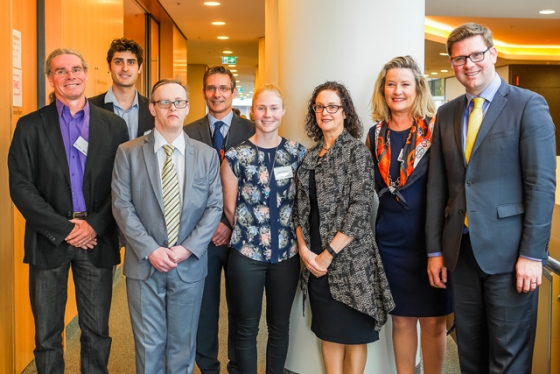
From left to right: A/Prof Philip Ward, Dr Simon Rosenbaum, Mr Michael Sullivan, Prof Julian Trollor, Ms Jessica Bellamy,
Dr Jackie Curtis, Ms Arahni Sont, The Hon. Scott Farlow.